Key Takeaways: HPD Registration Requirements for NYC 2–4 Family Homes


• Most NYC 2–4 family rental properties must be registered annually with HPD (Housing Preservation & Development)
• Registration is required even if the building is owner-managed
• Owners must provide current ownership and managing agent information
• Failure to register can result in violations and limit an owner's ability to enforce certain housing-related claims in court
• HPD registration must be updated whenever ownership or management information changes
• Owner-occupied buildings with rental units are often still required to register
• The registration requirement is separate from property taxes, permits, and other city filings
• Tenants, city agencies, and emergency personnel may rely on HPD registration records to identify responsible parties


Understanding HPD Registration Beyond the Headlines


Many small landlords assume HPD registration only applies to large apartment buildings or professionally managed properties. In reality, most NYC residential buildings containing rental units—including 2–4 family homes—must maintain a current registration with HPD.


The purpose is straightforward: the city wants accurate information about who owns and manages residential rental properties. This helps ensure there is a responsible contact when housing issues, emergencies, or violations arise.


Who Must Register?


In most cases, owners of 2–4 family properties with at least one rental unit are required to register with HPD.

The registration includes information such as:


• Property ownership details
• A mailing address for the owner
• Managing agent information, if applicable
• Emergency contact information


Even if you personally manage the property and live nearby, registration may still be required.


What Happens If You Don't Register?


Failure to maintain a valid HPD registration can create unnecessary problems for property owners.

Potential consequences include:


• HPD violations for failure to register
• Difficulty bringing certain housing-related cases in Housing Court
• Delays when dealing with tenant complaints or city agencies
• Outdated ownership records that create confusion during emergencies


Many owners discover registration issues only when they need to file a case or respond to a city notice.


Bottom Line for Small Property Owners


HPD registration is one of the most commonly overlooked requirements for NYC 2–4 family landlords. If your property contains rental units, maintaining an up-to-date registration is typically mandatory regardless of whether you use a management company. Keeping registration current helps avoid violations and ensures city agencies can reach the correct responsible party when needed.


June 17, 2026
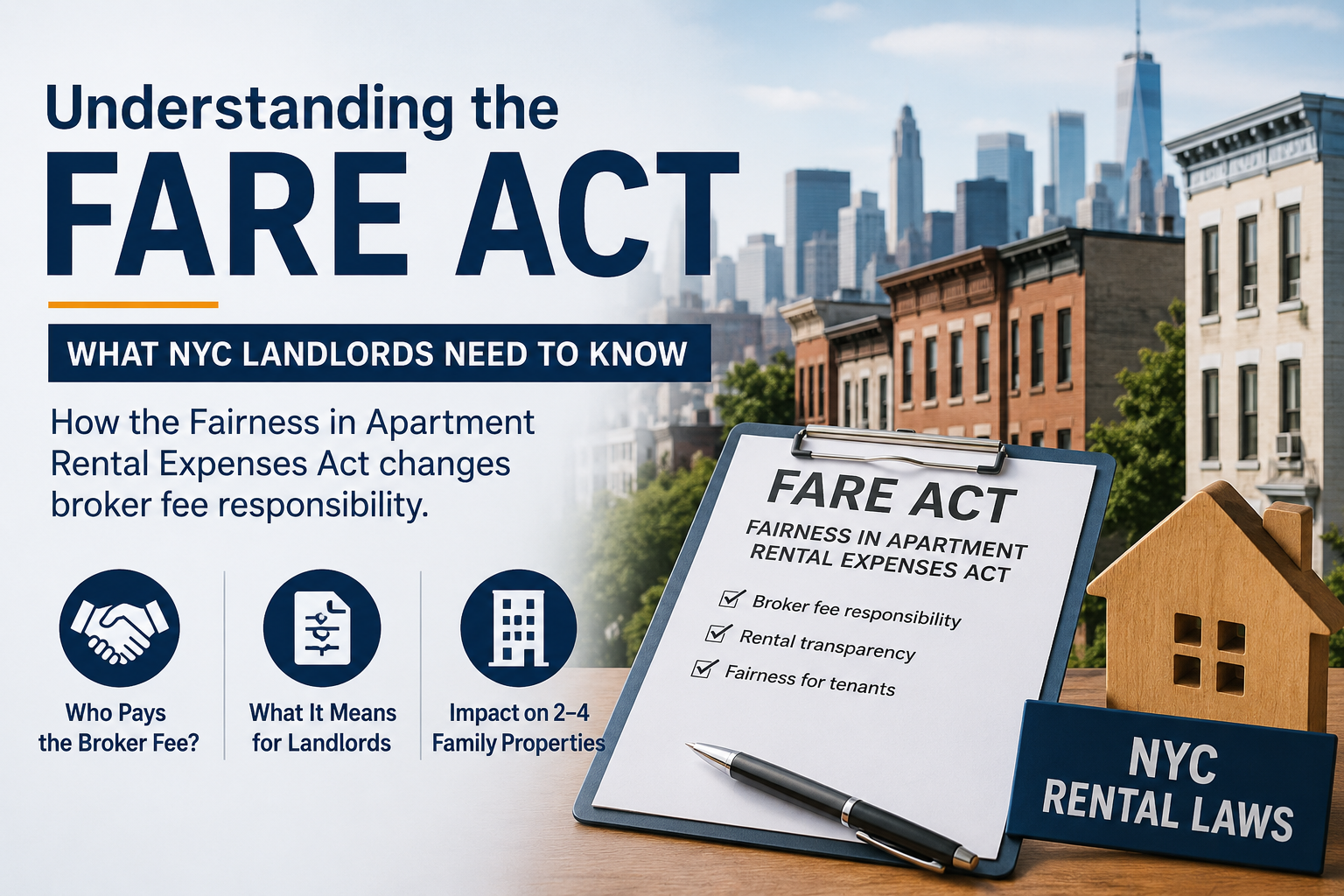
Key Takeaways: NYC FARE Act (Fairness in Apartment Rental Expenses) • The FARE Act requires the party who hires the broker to pay the broker fee in NYC rentals • Landlords who use brokers for leasing are now typically responsible for paying commissions • Tenants generally should not be charged broker fees when they did not hire the broker • The law changes cost allocation, not whether brokers are used in rentals • Small landlords may see higher upfront leasing costs when listing through agents • Private rentals without brokers are usually unaffected • “No-fee” listings increase for tenants, but fees still exist on the landlord side • Misunderstanding is common because broker fees are not eliminated, just reassigned Understanding the FARE Act Beyond the Headlines The FARE Act in NYC addresses how broker fees are assigned in residential rentals. Historically, tenants often paid broker fees even when the broker was working for the landlord. That mismatch is what the law is trying to correct. Instead of removing broker fees, the law ties payment responsibility to who actually hires the broker. In most standard rental listings, that means the landlord. What This Means for Small Property Owners For small landlords, especially owners of 2–4 family buildings, the practical change is financial timing. If you list a unit through a broker, you should expect to cover the broker’s commission rather than passing it to the tenant at lease signing. If you handle leasing yourself, or rent without a broker, the law doesn’t really change your process. Bottom Line for Small Property Owners The FARE Act does not remove broker fees from NYC rentals. It shifts them. Small landlords using brokers will see higher upfront leasing costs, while tenants are generally no longer charged fees for brokers they did not hire.
By Adrian Caramihai February 6, 2026
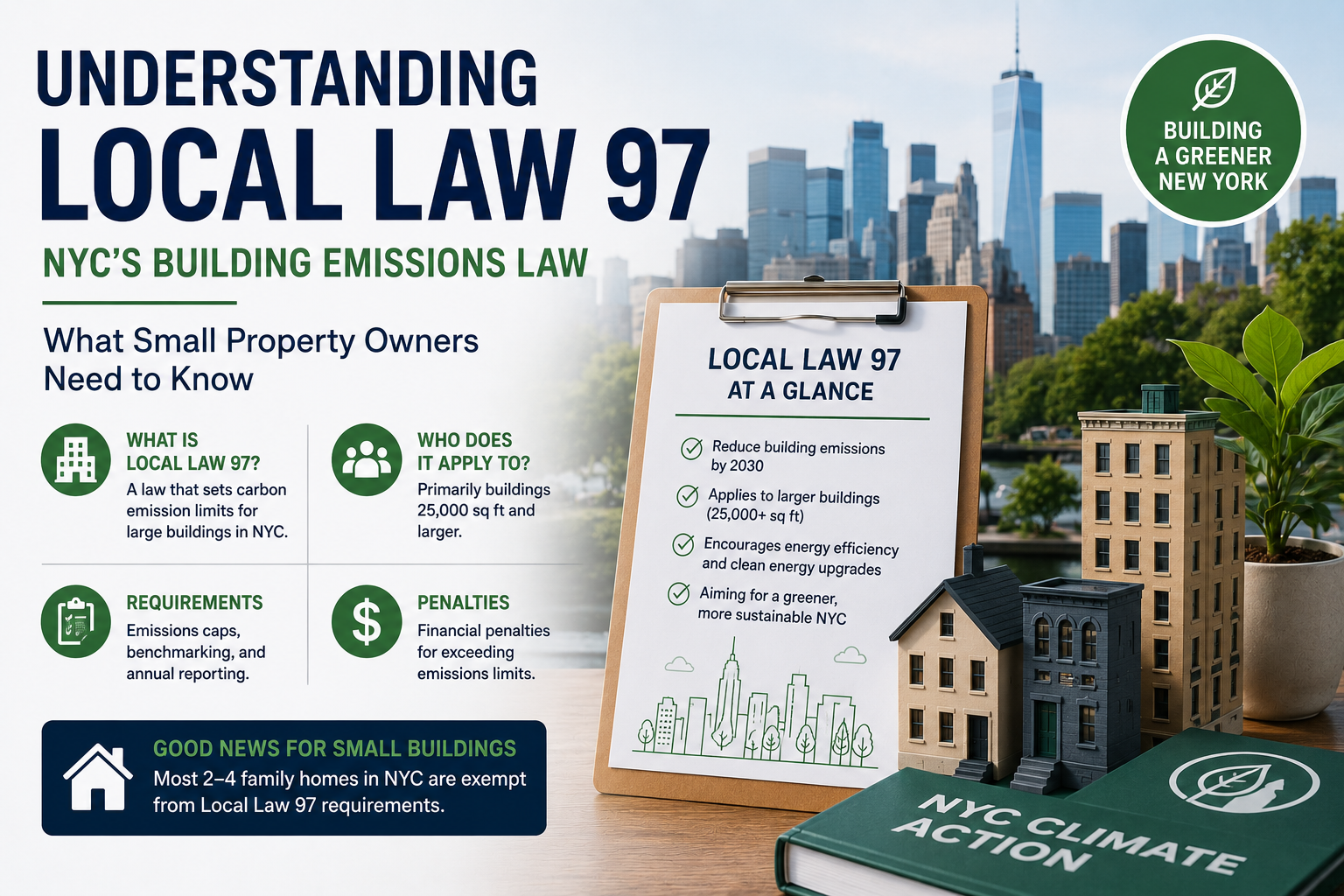
Key Takeaways: Local Law 97 & Small Residential Buildings (Article 321) • Most 2–4 family properties in NYC are NOT subject to Local Law 97 • Buildings under 25,000 square feet are exempt from emissions caps, penalties, and reporting • Article 321 explicitly excludes small residential buildings from compliance requirements • No carbon limits, benchmarking, or annual filings apply to these properties • Owners of 2–4 family homes do not need to retrofit to meet Local Law 97 • “Prescriptive Energy Conservation Measures” are not mandatory for exempt buildings • Measures like pipe insulation or heat timers are optional, not legally required • The law primarily targets large apartment buildings and commercial properties • Small landlords face no fines now or in future compliance periods • Energy upgrades may still reduce operating costs, but are voluntary • Local Law 97 is often misunderstood because most coverage focuses on skyscrapers • For typical 2–4 family owners, Local Law 97 is a non-issue from a legal standpoint ________________________________________ Understanding Local Law 97 Beyond the Headlines Local Law 97 was enacted to reduce carbon emissions from New York City’s largest buildings, which account for the majority of energy use citywide. As a result, most media coverage focuses on high-rise apartments and commercial towers—leaving small property owners confused about whether the law applies to them. For owners of 2–4 family homes, the answer is usually simple: it doesn’t. Under Article 321, residential buildings under 25,000 square feet are exempt from Local Law 97’s emissions limits, reporting obligations, and financial penalties. This exemption covers the vast majority of 2–4 family properties in NYC. ________________________________________ What Are “Prescriptive Energy Conservation Measures”? Prescriptive Energy Conservation Measures are a compliance option for covered buildings, allowing them to meet the law through basic energy upgrades instead of calculating emissions. Common examples include: • Insulating exposed hot water or steam pipes • Installing boiler heat timers or outdoor temperature controls • Using LED lighting and occupancy sensors in common areas • Implementing temperature setbacks during low-use hours These measures are often mentioned in Local Law 97 discussions—but they are not requirements for exempt buildings. ________________________________________ Do 2–4 Family Owners Need to Install These Measures? No. If your building is under 25,000 square feet, these upgrades are not required, not inspected, and not reported to the city. Some owners still choose to install them to reduce fuel costs or improve comfort, but that decision is purely optional. ________________________________________ Bottom Line for Small Property Owners Local Law 97 was not designed with small residential landlords in mind. For most 2–4 family properties, it creates no legal obligations, no penalties, and no compliance burden. Understanding this distinction can save owners unnecessary stress—and unnecessary spending.
By Jarred Traub February 2, 2024
Property management can be a complicated song and dance which always requires a fine attention to detail. One facet that does not receive...
By Jarred Traub January 31, 2024
Creating and maintaining a proper budget is critical for success when managing a property. Having a well-thought-out budget provides you...
By Jarred Traub January 25, 2024
Being proactive and having the right maintenance plan in place can significantly reduce long term expenses.
By Jarred Traub January 18, 2024
Owning and managing rental properties can be a lucrative venture but can also come with its own set of challenges. It can be commonplace...
By Adrian Caramihai February 19, 2023
The number of new Manhattan condominiums sold in January declined to match the average monthly sales between 2015 and 2020. Although...
By Adrian Caramihai February 15, 2023
The Good Cause Eviction law of the City of Albany (Local Law F of 2021) was in direct conflict with and preempted by New York State law,...
By Adrian Caramihai February 15, 2023
The NYC Renewal Lease Form (RTP-8) has been updated by DHCR to include the guidelines specified in Rent Guidelines Board Order #54. The...